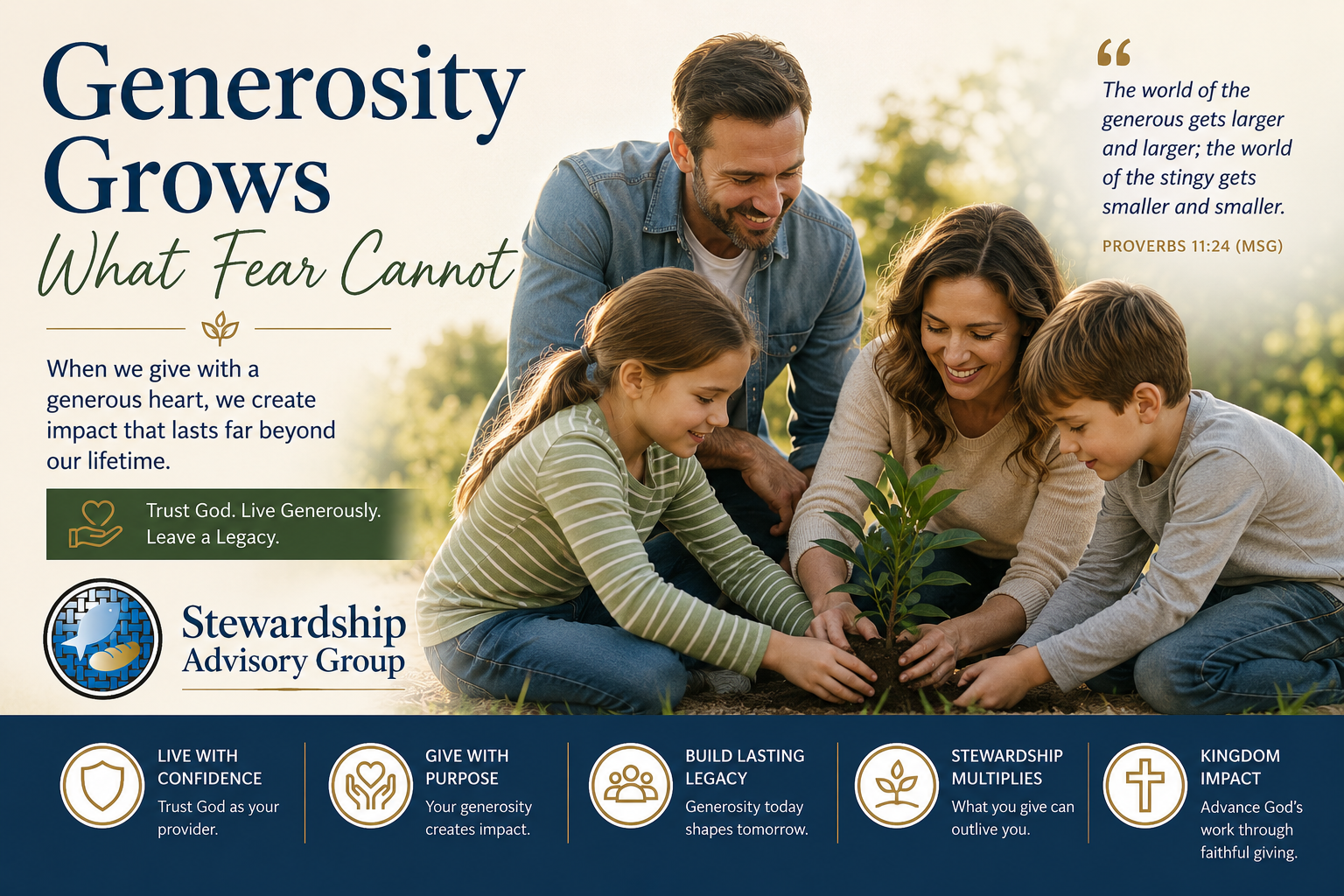
Fear and generosity rarely grow in the same soil.
Fear tells us to hold tighter, protect more, and trust less. It whispers that there may not be enough tomorrow, so we should cling to everything today.
Generosity, however, flows from a different mindset entirely. It reflects trust rather than scarcity, confidence rather than anxiety, and faith rather than fear.
At Stewardship Advisory Group, we believe generosity is not simply a financial decision—it is a spiritual posture. And over time, generosity grows what fear never can: peace, impact, unity, and lasting purpose.
Fear Shrinks Our Perspective
Financial fear often disguises itself as wisdom.
It can sound responsible:
“What if something happens?”
“What if the market changes?”
“Or what if I don’t have enough later?”
While prudent planning is wise, fear-based living slowly narrows our vision. It shifts our focus entirely toward preservation and protection. Over time, fear can make us reluctant to give, hesitant to help, and resistant to trust.
Jesus repeatedly addressed this mindset because He understood how easily fear can master the human heart. In Matthew 6, He reminded His followers that worry cannot add a single hour to life. Fear promises control, but it rarely produces peace.
Generosity Reflects Trust
Generosity begins with the recognition that everything we have ultimately belongs to God.
We are not owners—we are stewards.
That perspective changes how we hold resources. Instead of operating from scarcity, we begin to live from stewardship. We recognize that financial wisdom is not merely about accumulation, but about alignment with God’s purposes.
Generosity says:
“I trust God to provide.”
“I believe resources can serve a greater purpose.”
“And I want my finances to reflect my faith.”
This does not mean ignoring planning or wisdom. In fact, strategic generosity is often one of the clearest expressions of thoughtful stewardship.
What Generosity Produces
Fear focuses on what might be lost. Generosity focuses on what can be multiplied.
Over time, generous living produces things that cannot always be measured on a spreadsheet:
- Stronger communities
- Kingdom impact.
- Family values rooted in gratitude.
- Greater joy and contentment.
- Freedom from the constant pressure of accumulation.
Generosity also shapes future generations. Children and grandchildren often learn more from what we prioritize than from what we say. When generosity becomes part of a family culture, it leaves a legacy far beyond financial assets.
Generosity Requires Intention
Most people intend to be generous someday. But generosity rarely becomes consistent without intentional planning.
Just like investing, generosity grows through consistency.
This may include:
- Setting aside planned charitable giving.
- Supporting ministries or missions regularly.
- Teaching children to give faithfully.
- Including charitable impact within long-term planning.
- Viewing financial success as an opportunity to serve others.
- Generosity is not reserved for those who “have extra.” It begins with the willingness to live open-handedly.
- The Freedom of Open-Handed Living
One of the greatest benefits of generosity is freedom. Fear clenches. Generosity releases.
When money becomes our source of security, anxiety often increases alongside accumulation. But when finances are viewed as tools rather than ultimate treasures, peace begins to grow.
This is why Scripture consistently connects generosity with joy. Open-handed living frees us from the exhausting burden of believing everything depends solely on us.
It reminds us that provision ultimately comes from God—not from our ability to control every outcome.
A May Invitation
Spring is a season of growth. Seeds planted consistently over time eventually produce a harvest. The same is true spiritually and financially.
This May, consider asking:
Does fear influence any of my financial decisions?
Is generosity intentionally built into my plan?
What values am I modeling for future generations?
How can my resources create greater Kingdom impact?
Often, the greatest growth begins not by holding tighter—but by trusting more deeply.
Growing What Matters Most
At Stewardship Advisory Group, we believe wise financial planning and generous living belong together. Stewardship is not simply about preserving wealth—it is about using resources intentionally to reflect faith, wisdom, and purpose.
Because generosity grows what fear cannot.
And over time, a life marked by open-handed stewardship leaves an impact far greater than accumulation alone.
Yours for Faithful Stewardship,
Jeff Rogers, CEP®, CKA®