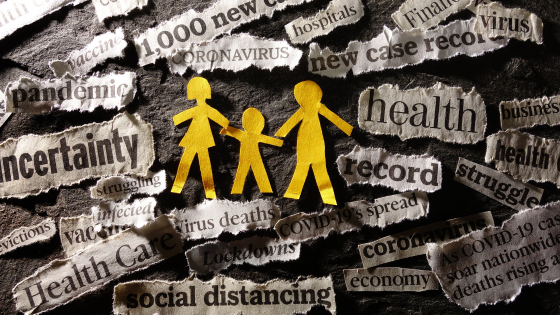
If your stress and anxiety levels are reaching a breaking point, you’re not alone. A recent Kaiser Family Foundation (KFF) poll found 45 percent of adults in the United States are feeling worry and stress related to the coronavirus. Steps taken to reduce loss of life – social distancing, non-essential business closures, remote work, lack of daycare, shelter-in-place orders, online school – have caused many people to feel overwhelmed or isolated or both. Anxiety has been triggered by uncertainty about the future and concern loved ones may become ill.1 Fortunately, there are actions we can take for coping with pandemic stress. For instance, you can:
Take a news detox.
Being bombarded with news and information can be distressing and take a toll on your well-being. As a result, it may benefit you to take a break from watching, listening, and/or reading pandemic updates. Reducing social media consumption may help, too.2
Use the extra time for activities that are more constructive and less upsetting. You could listen to music, practice yoga, meditate, listen to a funny audio book, go for a walk, or do something else you enjoy.2
Make it about you.
For some people, stress and anxiety negatively affect immune response. Take some steps to boost your immune system. Harvard Health recommends:3
• Don’t smoke
• Eat a diet high in fruits and vegetables
• Exercise regularly
• Maintain a healthy weight
• Drink alcohol only in moderation
• Get enough sleep
Connect and reconnect.
Sheltering in place may keep you safe from the virus, but isolation can have negative mental health repercussions. On the PsychCentral blog, Susan Zinn recommends interacting with neighbors from a safe distance. Sharing a wave and a smile on daily walks, and participating in digital family get-togethers can lift your spirits.4
No one knows how long the pandemic will last or what life will be like in the years ahead. Coping with uncertainty is easier when you take control of things you can influence.
Cooking Is Chemistry
If you recently began a new hobby, like baking, to help ease your mind and lift your spirits, why not create a teaching opportunity? All you need is delicious cupcakes, toothpicks, and some berries to create a potential home-science lesson for stay-at-home kids or grandkids.
Building Cupcake Molecules
Ingredients
12 cupcakes with different colors of frosting
3 kinds/colors of berries or marshmallows
Designate each color of frosting as an element (e.g., brown is carbon, blue is oxygen). Use fruit/marshmallows as elements, too.
- H2O cupcakes: Take a blue/oxygen cupcake and use toothpicks to attach two hydrogen raspberries (or a specific color of marshmallow) to mimic the structure of a water molecule.
- CO2 cupcakes: Connect two blue/oxygen cupcakes using toothpicks to attach a single carbon blueberry (or a specific color of marshmallow) to mimic the structure of carbon dioxide molecule.
- CH4 cupcakes: Take one brown/carbon cupcake and use toothpicks to attach four hydrogen pineapple chunks (or a specific color of marshmallow) to mimic the structure of a methane molecule.
You can find simple lessons for teaching elements and molecules online. When you tire of making molecules, enjoy your delicious treats!
Sources:
1 https://www.kff.org/coronavirus-covid-19/issue-brief/the-implications-of-covid-19-for-mental-health-and-substance-use/ (or go to https://peakcontent.s3-us-west-2.amazonaws.com/Peak+Documents/LN_3rd_Qtr_2020_KFF-The_Implications_of_COVID-19_for_Mental_Health_and_Substance_Use.pdf)
2 https://www.cdc.gov/coronavirus/2019-ncov/daily-life-coping/managing-stress-anxiety.html
3 https://www.health.harvard.edu/staying-healthy/how-to-boost-your-immune-system
4 https://psychcentral.com/blog/the-importance-of-staying-connected-while-practicing-social-distancing/This material was prepared by Carson Coaching. Carson Coaching is not affiliated with the named broker/dealer or firm.